student education
News Update
Loading...

Saturday, March 24, 2018

Consider Applying Early in student usa

Consider Applying Early in student usa


Bookbag in empty classroom
Many U.S. colleges require undergraduate and graduate students to submit standardized test scores as part of their application packages. Learn more about taking required tests.

Develop a Timeline or To-Do List

Careful planning will help make the college application process less stressful. To help you out, we’ve developed several college preparation checklists. The checklists are for students (of all ages) who are considering college or career school. We also have information for parents. Even if you are getting a late start, we have a checklist for you.
Top

Picture of hands texting in front of notebook
Remember: The financial aid application process is separate from the admissions application process. The financial aid process includes the essential step of completing the Free Application for Federal Student Aid (FAFSA®) form to apply for federal student aid. You also should consider applying for scholarships and other types of aid.

Consider Applying Early

If you are confident that you are academically prepared and want to get into a particular school, you might want to consider early application programs for undergraduate admissions. When you apply early to a school, you’re speeding up the entire application process. Instead of submitting your application in November or later in your senior year, you usually need to begin the application process in September.
Applying early can sometimes give you an advantage. At some schools, a higher percentage of early applicants are accepted. And if you do get early acceptance, you can skip a couple of months of stress and uncertainty. You also can get a head start preparing for your freshman year.
While procedures at individual colleges may vary, the two most common procedures are early decision and early action. Some schools have both procedures. Another option is called dual enrollment.

Early Decision

If you have a particular school in mind that is your “first choice,” early decision might work well. If you are accepted under early decision, you must attend that school, unless its financial aid package is too low for you to attend. (If you’re not sure whether the school’s financial aid offer will be enough, make sure to submit applications to other schools.) Usually, you can apply to only one school for early decision. You can still apply to other schools at their regular application deadlines.

Early Action

Early action is similar to early decision, but you aren’t “locked in” to attending a school that accepts you. Some schools allow you to apply for early action at other schools at the same time, but some don’t. Know the rules. In addition, under early action, you can still apply to other schools at their regular application deadlines. Keep in mind that there is less incentive for an early action college to accept you because you aren’t committing to attend the school.

Dual Enrollment

A third option, dual enrollment, is typically for high school juniors who have most of the credits needed for graduation. If this applies to you, then you may want to consider taking college-level courses during your senior year. Then you could continue your college education at that college after you graduate from high school, or you could transfer the credits to another college. Work with your high school guidance counselor to see if this would be a good option for you.

Considerations When Applying Early

If you are thinking about using the early application process, consider the following tips:
  • Sit down with your guidance counselor, who can explain the pros and cons of applying early to certain schools.
  • If you’re really interested in a particular school, contact that school well ahead of September to discuss its early application procedures and to see if applying early is the best option for you.
  • Ask yourself: Am I ready to make up my mind about where I want to go to college by October or November of my senior year? Will I be able to complete my applications, along with essays and recommendations, by late October or November?
  • Make sure you have thought about your career goals and whether the schools you are considering will help you reach those goals. For example, School A has an excellent journalism department, but School B has an outstanding mix of cultural and academic offerings. Our college search tool will help you find schools that may meet your needs.

Wondering what you need to do to apply for college or career school?

Applying to college, career school, or graduate school means more than just filling out forms. For a successful college application, you first need to understand each school’s admission requirements, gather information, meet deadlines, and pay any necessary fees. Plus, each school has different application requirements and deadlines, so it’s important to get organized.
While the application process may seem a little overwhelming, you can use the following information to get ready and figure out your next steps.

Narrow Your Application Choices

There’s no magic number when it comes to how many school applications you submit. One isn’t enough, because that school might not admit you. More than 10 might be too many because applications take a lot of work and you need to do a great job on each one. Also, most schools have application fees, so costs can add up. (Many schools waive fees for low-income students.)
The bottom line: Applying to a few schools that really interest you is better than applying to as many as you can.  If you’re not sure what schools might be right for you, see our information on choosing a school.


Research Admission Requirements Carefully

Every college has its own application requirements. Different programs within the same school may even request different items. Learn exactly what a school requires by visiting its website or checking with its admissions office.
Start preparing well before the application deadline and make sure to check and double-check everything before you submit it
Top

Wondering whether you can get your federal student loans forgiven for your service as a teacher?

Under the Teacher Loan Forgiveness Program, if you teach full-time for five complete and consecutive academic years in a low-income school or educational service agency, and meet other qualifications, you may be eligible for forgiveness of up to $17,500 on your Direct Subsidized and Unsubsidized Loans and your Subsidized and Unsubsidized Federal Stafford Loans.
If you have a Direct Consolidation Loan or a Federal Consolidation Loan, you may be eligible for forgiveness of the outstanding portion of the consolidation loan that repaid an eligible Direct Subsidized Loan, Direct Unsubsidized Loan, Subsidized Federal Stafford Loan, or Unsubsidized Federal Stafford Loan.

What are the eligibility requirements?

  • You must not have had an outstanding balance on Direct Loans or Federal Family Education Loan (FFEL) Program loans as of Oct. 1, 1998, or on the date that you obtained a Direct Loan or FFEL Program loan after Oct. 1, 1998.
  • You must have been employed as a full-time, highly qualified teacher for five complete and consecutive academic years, and at least one of those years must have been after the 1997–98 academic year.
  • You must have been employed at an elementary school, secondary school, or educational service agency that serves low-income students (a "low-income school or educational service agency").
  • The loan(s) for which you are seeking forgiveness must have been made before the end of your five academic years of qualifying teaching service.
     

Teaching for Less Than a Complete Academic Year

If you were unable to complete a full academic year of teaching, that year may still be counted toward the required five complete and consecutive academic years if
  • you completed at least one-half of the academic year;
  • your employer considers you to have fulfilled your contract requirements for the academic year for the purposes of salary increases, tenure, and retirement; and
  • you were unable to complete the academic year because
    • you returned to postsecondary education, on at least a half-time basis, in an area of study directly related to the performance of the teaching service described above;
    • you had a condition covered under the Family and Medical Leave Act of 1993 (FMLA); or
    • you were called or ordered to active duty status for more than 30 days as a member of a reserve component of the U.S. armed forces.

EducationUSA Interactive: Exploring Community Colleges

 
EducationUSA Interactive: Exploring Community Colleges
This program features Alfred Boll, representing EducationUSA in the Bureau of Educational and Cultural Affairs at the United States Department of State, Dr. Anize Appel is the Assistant Director for the Center for International Education at the Northampton Community College located in Bethlehem, Pennsylvania, Heidi Russell-Kalkofen is the International Student Coordinator at Montgomery College, located just outside Washington DC, Camila Matamoros, who is a student at Montgomery College from Cali, Colombia and Kelvyn Osoria a participant in the Community College Initiative Program from the Dominican Republic. Go one step further on your journey to study in the USA!

EducationUSA Interactive: Your Student Visa Questions Answered

 
EducationUSA Interactive: Your Student Visa Questions Answered
Are you ready to study in the United States, but have questions about getting a student visa? On April 27, 2017, visa expert Laura Stein and international student coordinators Twyla Jones and Jennifer Donaghue provided an overview of the multi-step student visa process and answered student questions from around the world. Watch this recording to get answers to questions such as: What forms do I need to fill out? How do I prepare for my visa interview? How long does it take to get a visa? Moderator: Alfred Boll, EducationUSA, U.S. Department of State Speakers: Laura Stein, Visa Policy Analyst, Bureau of Consular Affairs, U.S. Department of State; Dr. Twyla Jones, Assistant Coordinator for International Students, Northern Virginia Community College; Jennifer Donaghue, Director of the International Services Office, George Washington University
For: International Students
Topics covered: General, Step 4: Apply for Your Visa
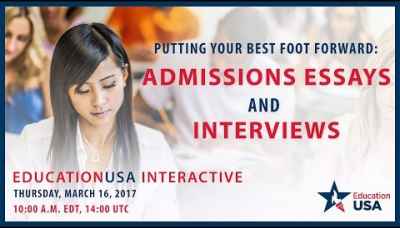
EducationUSA Interactive: Admissions Essays and Interviews

EducationUSA Interactive: Admissions Essays and Interviews


EducationUSA Interactive: Admissions Essays and Interviews
How can I make a good impression through my admissions essays or interview when I apply to university? In this EducationUSA Interactive episode, experts on American higher education offer information and advice on how to “put your best foot forward” with your admissions essays and interviews. This moderated conversation answered questions submitted live from an online audience and covered issues such as selecting essay topics; drafting, editing and reviewing essays; learning how colleges evaluate and weigh essays; and how to prepare for an interview. Moderator: Alfred Boll, EducationUSA, U.S. Department of State Speakers: Susan Strow, Columbia Chicago; Karen Binger Marshall, Appalachian State; and Murphy Miller, George Washington University.
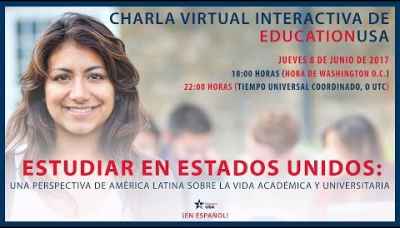
Estudiar en Estados Unidos: Una perspectiva de América Latina

Estudiar en Estados Unidos: Una perspectiva de América Latina

 
Estudiar en Estados Unidos: Una perspectiva de América Latina (full episode)
 ¿Eres estudiante o padre de un estudiante de América Latina que se pregunta cómo es realmente estudiar en una universidad en Estados Unidos? En ese caso, ¡Este charla virtual interactiva de EducationUSA de EducationUSA es para ti! Únete a expertos en educación superior que representan a colegios universitarios y universidades estadounidenses con programas de dos y cuatro años, estudiantes latinoamericanos matriculados en la actualidad, y un funcionario del Departamento de Estado de Estados Unidos para participar en un seminario interactivo de EducationUSA sobre la vida académica y universitaria diarias tal y como las experimentan estudiantes universitarios de América Latina en Estados Unidos. Haz preguntas y conoce lo que están haciendo los recintos universitarios de Estados Unidos para dar la bienvenida a estudiantes latinoamericanos e internacionales. Alfred Boll, EducationUSA, U.S. Department of State Gerardo Alan Mendoza Sosa (“Alan”), Student at Brown University (Class of 2020) Dr. Gabriela Polit, Profesora Asociada, Departamento de Español y Portugués, Universidad de Texas en Austin Yosimi Mitsuta, Student, University of Texas at Austin William Velez, Assistant Director of International Admissions and Recruitment and Chair of Study Oregon Consortia, Chemeketa Community College Juan Diego Quintero, Student, Chemeketa Community College
For: International Students
Topics covered: General, International Student Story, Step 5: Prepare for Your Departure

Featured

[Featured][recentbylabel]

Featured

[Featured][recentbylabel]
Notification
This is just an example, you can fill it later with your own note.
Done